Visiting the Musée d'Orsay Without a Tour
Plenty of people should visit this museum without a guide, and the museum makes it easy to. This guide covers where to buy, which door to use, how to walk the building on your own, and where the independent route quietly costs you time.
In this guide
- Can you visit without a guide?
- Where admission is sold
- Do you still queue with a timed ticket?
- Which entrance you use
- What the audio guide covers
- A self-guided route that works
- Independent and guided, side by side
- What going alone saves
- What no ticket can buy
- Where independent visitors lose time
- Who should still book a guide
- When your slot is sold out
- Common questions
Can you visit the Musée d'Orsay without a guide?
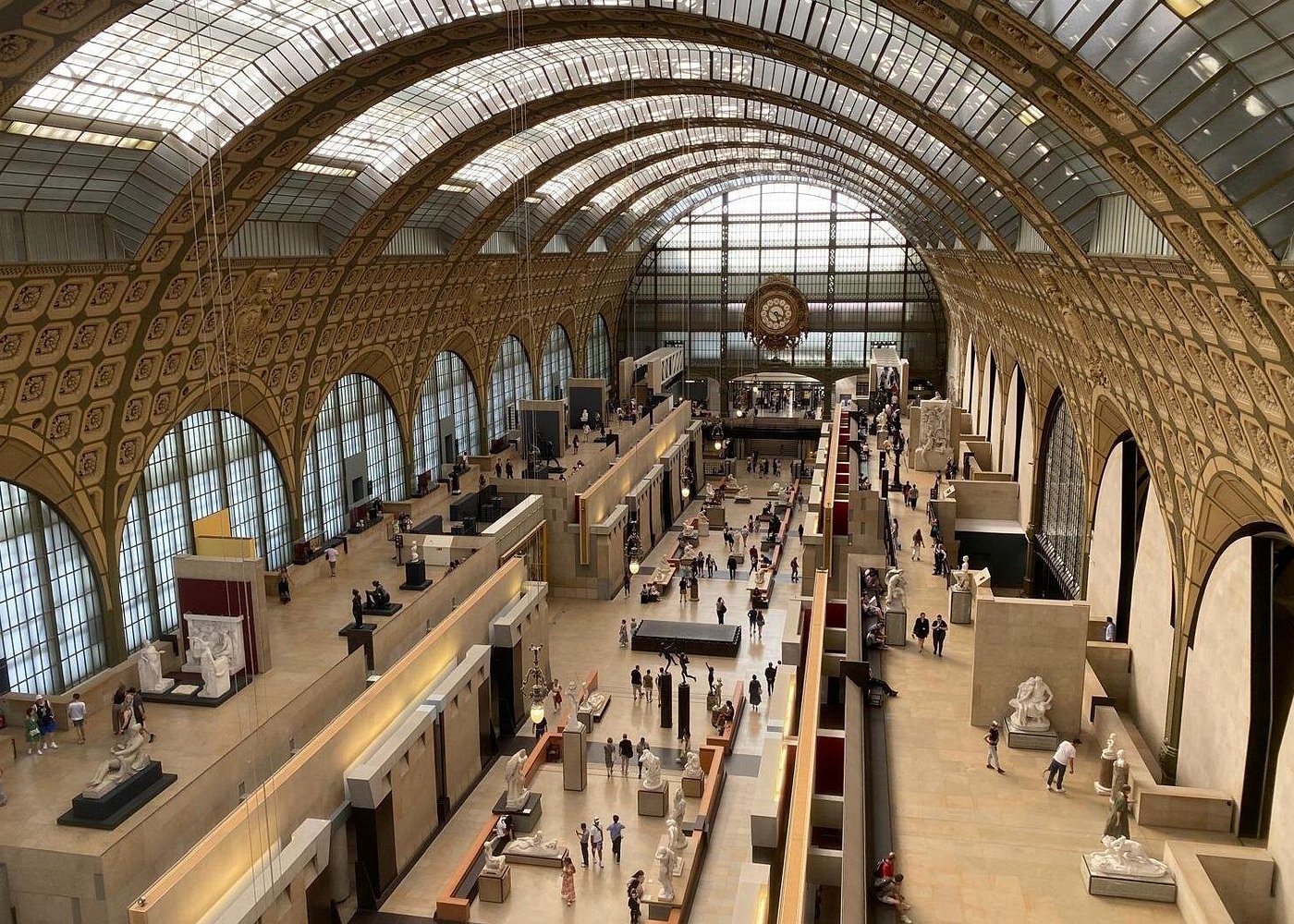
Yes, and a large share of visitors do. The museum is built for independent visiting: one building, three levels, bilingual labelling, and a layout that runs chronologically once you know to start at the top.
The question worth asking is not whether you can, but what you want from the two hours. Independent visiting buys freedom and costs you interpretation. Everything below is about making that trade knowingly rather than by accident.
It also helps that the building is small by Paris standards. One former station, three levels, and a single spine you can walk end to end in five minutes. Nobody gets lost here the way they do in the Louvre, which removes the main practical argument for hiring somebody to lead you around.
Where admission is actually sold
There are three routes in, and they are not equivalent.
- The museum's own ticketing, at billetterie.musee-orsay.fr. Museum-issued admission, the current full rate, and the only place to book the free first-Sunday slots.
- Booking platforms, which sell timed admission from $23 and often route you through a dedicated entrance. Convenient if you are booking other things at the same time.
- The desk on the day, which works outside peak season and is a gamble in July.
The difference that matters is what happens when something goes wrong. Museum-issued admission follows the museum's own conditions. Platform bookings here carry a written 24-hour cancellation window, and one of them allows a reschedule before departure, which is the more forgiving arrangement if your dates are still moving.
Do you still queue with a timed ticket?
Yes — a short one. A timed ticket removes the ticket-buying queue, not the security screening every visitor passes through. Bags are checked, and at busy hours that line runs to fifteen or twenty minutes.
What the ticket does buy is certainty. You know you are getting in, at a time you chose, and you are not standing in the longer line of people still deciding. Arrive about fifteen minutes before your slot and the screening absorbs into the wait you had planned anyway.
Screening is quicker with less to check. A small bag goes through in seconds; a rucksack with a laptop and a water bottle takes longer, and large luggage is not admitted at all. Travel light and the queue you were dreading turns out to be four minutes.
Which entrance do you use?
The door depends on what you hold. Independent visitors with an advance ticket use the signed entrance for pre-booked admission; some platform tickets specify their own dedicated door and print it on the voucher. Read yours before you set off, because the entrances sit at different points along the Esplanade.
Visitors with a disability and one companion enter free through the priority Entrance C, on proof of eligibility, with no advance reservation and no need to collect anything at a desk.
What the museum's own audio guide covers
The museum rents an audio guide at the desk for a few euros, covering the works most people stop at across the three levels. It is a commentary track, not a route: it tells you about a painting once you are standing in front of it.
One listing here takes the other approach and emails you a one-hour digital audio guide the day before, alongside your admission, from $41. You use your own phone and headphones, which is worth knowing before you arrive without either.
A self-guided route that works
Start at the top and walk down. It is the single most useful piece of advice for an independent visit, and it is the opposite of what the building invites you to do.
- Level 5. The Impressionist collection, while you are fresh and the rooms are still quiet. Monet, Renoir, Degas, Van Gogh, Cézanne.
- The clock. Behind the glass face, with the Right Bank through it.
- Level 2. The late nineteenth century, Art Nouveau, and the gilded ballroom.
- Level 0. The nave: Courbet, Manet, and the sculpture down the middle of the old station floor.
The Musée d'Orsay collections page sets out what sits on each level, and the highlights covers the individual works in the order they come.
Give the route a shape before you arrive rather than deciding room by room. Pick six works you want to stand in front of, in the order the levels come, and treat everything else as what you find on the way. That single decision is most of what a guide does for you, and it takes ten minutes the night before.
Independent and guided, side by side
| Independent | Guided | |
|---|---|---|
| Cost per person | From $23 | From $69 |
| Time inside | As long as you like, up to 4 hrs | 1.5–2.5 hrs, fixed |
| Entry | Timed slot, then screening | Reserved slot, dedicated door, then screening |
| Route | Yours | Set by the guide |
| Interpretation | Labels, or an audio guide | A person answering questions |
| Best for | Repeat visits, drawing, a slow morning | A first visit with limited time |
What does going alone actually save?
Roughly $45 to $60 per person against a guided tour, which for a family of four is the price of dinner. It also saves you a fixed start time, which on a loosely planned day is worth as much as the money.
What it does not save is preparation. A good independent visit needs half an hour of reading beforehand — which works to see, which level they are on, and what order to walk. Skip that and the saving turns into wandering.
The saving also shifts with group size. One person choosing between a $23 ticket and an $82 tour is weighing $59; a family of four is weighing the whole cost of the day. Children under 18 enter free on admission but usually occupy a paid place on a capped tour, which widens the gap further.
What no ticket can buy you
Context, mostly. A label tells you a picture is Manet's Olympia, painted in 1863. It does not tell you why the painting caused a scandal, or what a viewer in 1865 saw that a viewer today walks past.
The second thing is prioritisation. Guides have decided in advance what to skip, which is the hardest decision to make while standing in a room full of famous paintings with tired feet and a train to catch.
Where independent visitors lose time
Three places, all avoidable. Starting on the ground floor and reaching the Impressionists at their busiest. Queueing for the cloakroom at 10 a.m. with everyone else, rather than at a quieter moment. And leaving the building for lunch, which on a single-entry ticket means the visit is over.
The fix for all three is sequencing rather than speed. Go up first, drop your coat when the desk is clear, and eat inside if you intend to stay past midday.
There is a fourth, quieter one: reading every label. Full attention on a wall text costs about a minute, and there are hundreds of them. Read the labels for the works you came for and let the rest carry you along, or the last hour disappears somewhere on the middle level.
Who should still book a guide?
Anyone visiting once, with under two hours, who wants to leave understanding what they saw. Anyone travelling with someone who will lose interest without a voice to follow. And anyone who finds crowded rooms hard to navigate, where a small group gives you a position and a pace.
The tour or ticket comparison does the arithmetic on that decision if you are weighing the two on price.
What to do when your slot is sold out
Check the Thursday evening first — the late night runs to 9:45 p.m. and often has availability when daytime slots do not. After that, look at guided tours, which hold their own reserved entry slots and are frequently bookable when general admission is not.
The two-museum combo is a third route in, since it carries its own dedicated entrance. Failing all of that, a same-day walk-up outside peak season usually works, particularly after 3 p.m.
Slots also come back. Cancellations release inventory through the day before, so a listing that showed nothing on Monday often has space by Wednesday evening. Check once more the night before rather than rearranging the whole trip around a sold-out afternoon.
Common questions
Do you need a guide at the Musée d'Orsay?
Can you buy Musée d'Orsay tickets at the door?
Is the audio guide worth it?
Can you re-enter the museum on the same ticket?
What happens if you arrive late for your time slot?
Prefer to go in on your own terms?
Timed admission from $23, with free cancellation up to 24 hours ahead.
Compare tours and ticketsTickets for an independent visit
Timed admission, and the same admission with an audio guide if you want a voice in your ear.